by Emily Moaddel, BS | Jul 2, 2026 | Blog
The Urban Heat Island effect is a very well-known consequence of a city’s architecture. Black pavement, buildings, and other structures absorb sunlight and emit it back into the atmosphere, heating the city much more than a forested area. This is a very dramatic effect, creating a difference of 1-7℉ between cities and rural area temperatures. Do you ever feel the heat radiating off the pavement in a parking lot? Suddenly the weather doesn’t seem very bearable anymore. This effect occurs throughout cities as they are highly paved, leaving little room for nature. This can create issues for city dwellers who suffer from asthma or other respiratory illnesses, and causes an increase in heat-related illnesses in urban areas. As cities continue to experience elevated temperatures, city planners and landscape architects have turned to trees and green spaces as a method of reducing the impacts of the urban heat island effect.
But why trees? Trees provide shade, which, in urban areas, prevents sunlight from being absorbed by pavement. In addition, trees complete a process called evapotranspiration, which is when trees absorb water from the ground and then evaporate this water through their leaves. The atmospheric cooling is a byproduct of this process, as the trees use warm air from the atmosphere to evaporate water, creating a cooling effect around them.
A study used models to adjust the tree cover across 93 European cities and found that increasing the tree cover to 30% could eliminate 2,644 out of 6,700 premature heat-related deaths in these 93 cities. In a world where the climate becomes a more present threat, it is even more important to do everything we can to regulate temperatures in urban areas, even if the difference seems small. An Environmental Health Perspectives article found that with each 1℉ increase in temperature during a heat wave, mortality risk rates increase by 2.49%. During a heat wave, 1℉ may not seem like a lot, but it does make a significant difference, even the difference between life and death for some. Having trees present in urban areas can reduce the intensity of heat waves, decreasing the mortality risk rates during these events.
At Global Health and Education Projects, Inc., we understand the importance of living in an urban or suburban area where you can feel comfortable, safe, and healthy. Utilizing the immense benefits of trees will allow your neighborhood and your family to thrive. Want to get your free trees, check out our Family Tree Adoption Program.
Sources:
by Emily Moaddel, BS | Jun 29, 2026 | Blog
Trees, especially in forests, are known for their ability to sequester carbon, acting as carbon sinks for the surrounding environment. While this is a common feature of forests, it is often expected that single trees would not be able to make an impact as significant as that of a forest. And while this assumption would be correct in the fact that one tree cannot do what an entire forest can, it is untrue when it comes to the impact per tree.
While a single tree in an urban area sequesters 4.5-11 kg of carbon, the same amount as a tree in a forest, it is responsible for avoiding the combustion of 18 kg of carbon annually. This discrepancy is due to the reduction in energy use that urban trees create by providing shade for buildings in the area, reducing their need for cooling. This makes the impact of one tree in an urban area equivalent to the impact of 3-5 trees in a forest.
When planting trees in your yard, there are many factors to consider. Do I want my tree to have fruit? Should it be deciduous or evergreen? Where should I plant my tree? This question is especially important as it could save a percentage of money allotted to paying for energy.
Depending on the shade provided by the tree and other factors affecting the area, each tree can provide up to $200 in energy savings over its lifetime. Maryland is a temperate region, which means that the tree must be placed to allow for the maximization of the sun to warm the house in the winter, provide shade in the summer, deflect winter winds away from the house, and bring summer breezes towards the home. Accounting for these conditions can reduce 25% of the energy used in your home.
In addition to saving money on utility bills, increasing the tree canopy in your neighborhoods can have significant reductions in carbon emissions at power plants, as less energy will be needed to keep homes cool. A study conducted in Sacramento, California, created a model where four trees would be planted in each yard. The model found that there would be a reduction of 60 kilotons of carbon emissions as a result of decreased energy consumption.
GHEP’s Family Tree Adoption Program (FTAP) allows Prince George’s County residents to select up to three free trees for their home. By participating in the FTAP, you can save money on energy bills and play a part in reducing Prince George’s County emissions! And that is a double take. The trees not only beautify; they also add to your pocket.
Sources:
by Emily Moaddel, BS | Jun 25, 2026 | Blog
In neighborhoods, trees are responsible for providing shade, a place for kids to play, beautiful scenery, and the increased presence of wildlife. The benefits seem to be endless. Over time, many have tried to correlate the presence of trees in a neighborhood with an increase in crime. They would blame the lack of visibility that trees create, giving criminals a window to act. However, the opposite has proven to be true.
The presence of trees in a community has been associated with a reduction in crime and violence. One influential study that has validated this claim was conducted in Baltimore, Maryland. In collaboration with the National Forest Service, the University of Vermont compared neighborhoods throughout Baltimore based on their tree coverage. To control for external variables, the neighborhoods compared had similar levels of income, housing age, race, housing type, population density, and additional factors. By controlling these factors, the study confidently concluded that in Baltimore neighborhoods where the tree canopy was 10% higher compared to other Baltimore neighborhoods, occurrences of violent crime were 12% lower.
Trees are not the cause of lower crime, but the results of this study create an association between the amount of trees in an area and the levels of crime in that area.
So, while trees will not offer the same deterrent that a video-camera doorbell or a ‘secured by ADT’ sign provides, trees may play a role in reducing neighborhood crime while improving your physical and mental health, and many other aspects of your life.
Similarly, a 2017 study conducted in Philadelphia, PA, asked men to retrace the paths they had walked before becoming a victim of gun violence. Using map layers, researchers placed a map with tree locations on top of the victims’ paths. Controlling for the time of day, researchers found that being under tree cover resulted in lower incidences of gun violence. Again, this is an association, similar to the last study, though it is important to note that
While these associations do not prove causation, it is important to note that trees seem to produce endless benefits. Planting trees in hopes of reducing crime could result in a source of food, a place for kids to play or read a book, or a new spot to birdwatch! The positives outweigh any negatives in this situation!
At GHEP, we are dedicated to addressing the social determinants of health and human development in order to eliminate disparities in health and education, one of which is safe neighborhoods and affordable housing. By investing in trees for your neighborhood and your communities, you know that you are not only beautifying your neighborhood, but you are doing your part in making your home safe! Do not wait; free trees are available through the Family Tree Adoption Program, which can be accessed at https://globalhealthprojects.org/tree-reservation/
Sources:
by Emily Moaddel, BS | Jun 23, 2026 | Blog
Trees are often seen as very self-sufficient and low-maintenance. This is, for the most part, true; however, newly planted trees often require some care to ensure that they get properly adjusted to their new environment and grow healthily. Studies have shown that the years of a tree’s establishment, which describes the first five years of the tree’s life, are accompanied by the highest mortality rates. Following these steps will reduce the chances of mortality, ensuring that you have a healthy, happy tree!
Water your tree!
While adult trees do not need to be consistently watered, young trees need to be given a consistent supply of water. Young trees should be watered every day for 2 weeks after planting. To water your tree, use a garden hose or a pitcher to water the soil around the tree, careful to avoid wetting the trunk, as this could promote fungus growth. While daily watering is recommended, if the ground around your tree is already moist, do not water it. Following the initial daily watering for 2 weeks, water your tree 2-3 times a week, and eventually once a week.

Protect your tree from wildlife.
If you notice damage on your tree similar to the image on the left, it is likely that rabbits or squirrels are likely using your tree bark as a snack. This is extremely harmful to the young tree, as it can stop sap from properly circulating the tree and expose the trunk to fungus, sometimes resulting in the death of the tree. To prevent this, consider purchasing a mesh tree guard to keep small animals away until your tree has grown thick enough bark to defend itself.
Should I prune my new tree?
You do not want to prune your new tree immediately. If the tree has damaged branches or intersecting branches, feel free to prune those. However, refrain from any cosmetic pruning as you do not want to slow tree growth or root development during its formative years. The establishment years of your tree should consist of nurturing your tree and providing the water and resources it needs to grow. Once your tree begins to grow and mature, cosmetic pruning will be more appropriate.

Look out for the spotted lanternfly! The spotted lanternfly, as shown to the left, is an invasive species that has been prevalent on the east coast for the past couple of years. While the spotted lanternflies are not known for killing trees, they can cause some damage. While feeding on a tree’s sap, spotted lanternflies discharge a sugary substance onto the tree that can cause mold to grow. This is not a significant concern if there are a few lanternflies and does not warrant pesticide use, but keep an eye out for lanternflies around your tree.
As you care for your new tree, we hope you see beautiful growth and integration into your yard! If you have any questions or concerns regarding the health of your tree, please reach out to us at [email protected]
Sources:
by Emily Moaddel, BS | Jun 6, 2026 | Blog
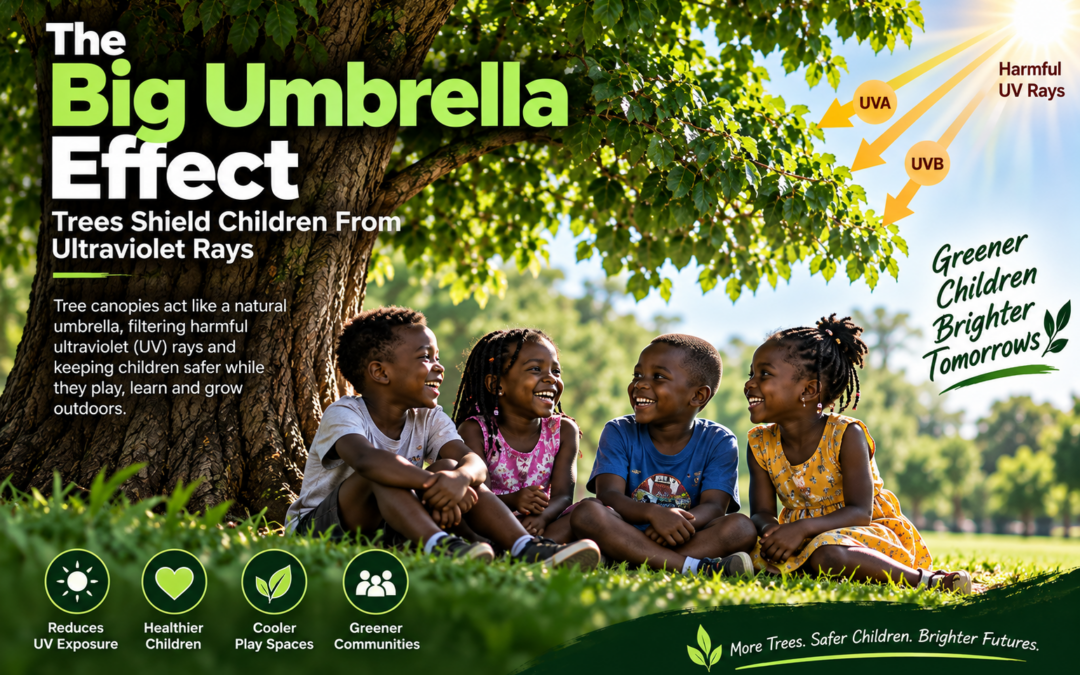
If you’re outside at a park or in your backyard on a hot, sunny day, all you want to do is find a shady spot to cool down. If you’re lucky, there will be a beautiful, big tree there to provide shade. Trees are a natural barrier to protect individuals from harmful ultraviolet rays. In the United States, skin cancer is the most common form of cancer. It is estimated that one in five Americans will have skin cancer at some point in their life. Given its prevalence, we must make every effort to create spaces where individuals can stay out of the sunlight while being able to enjoy the outdoors.
This is where the importance of trees comes in. Trees require little maintenance and immediately make a park or outdoor area more inviting. They provide a space for children and other parkgoers to rest from the sun, reducing their exposure to harmful ultraviolet rays. A study conducted by Purdue University found that if you stand in the full shade of a tree, the time it could take them to burn would be reduced from 20 minutes to 100 minutes. This is the equivalent to wearing SPF 10 sunscreen, and if you are already wearing sunscreen, it will increase the length of time that you are protected!
In addition to protecting children from the sun at parks or in their yards, trees make a big impact for pedestrians walking through neighborhoods or along roads. In neighborhoods, having trees in front of every house can provide a canopy cover over sidewalks and walkways, reducing the heat and sun exposure for pedestrians. A study conducted in Wisconsin measured the heat difference between streets that had no tree canopy and those that were at least 40% covered. The results found that if the tree canopy was at least 40% full, the temperature was reduced by 5-7℉. The restriction of sunlight provided by this canopy cover protects pedestrians from overexposure to the sun and reduces the effects of heat being absorbed and reflected back into the atmosphere.
Trees enhance parks, sidewalks, and many other places by providing shade and a cool atmosphere for people to join. GHEP’s Family Tree Adoption Program provides free trees for your yard, so your family can enjoy the outdoors and stay active while staying protected from ultraviolet rays. Get your tree now, and in only a few years, it will be providing shade for you, your family, and your neighbors!
Sources:
by Team GHEP | Nov 21, 2025 | Blog
You spent years getting your public health degree, only to find now that every employer requires experience that you don’t have. How’s that fair?
It isn’t. And you’re not alone either.
This is one of the biggest frustrations new public health graduates face. You finally reach the finish line, only to find it doesn’t matter. Job postings ask for “one to three years of experience,” even in entry-level positions.
The reality is, employers are looking for people who can get it done, not merely discuss it. They’re looking for problem-solvers who are ready to jump in and impact day one.
If you’re caught up in this experience gap, breathe a sigh of relief with us. We’re going to remedy it. In this article, we’re going to take you through straightforward, achievable steps to create experience, boost your confidence, and prepare for your first actual public health position.
Why Experience Matters in Public Health Hiring
Public health jobs can involve real individuals, dynamic problems, and timely decisions. That is why most employers want more than a diploma. They want experience.
Even certain entry-level jobs could require program planning, data collection, or health outreach abilities. Employers want candidates who can get up and running quickly with little training.
This can be infuriating, especially if you’ve just graduated. But the better news is that experience is not just gained from working full-time. Experience can be gained from short courses, volunteering, side-projects, or internships.
What’s key is that you can show what you’ve done, not what you’ve learned. In public health, it’s all about being able to apply what you know.
So let’s look at how to make that happen, even if you’re starting from scratch.
The Root of the Dilemma
Many public health degrees focus on theory and research, not hands-on practice. That means students often graduate without real-world experience.
Internships are limited, unpaid, or hard to find. And students from underserved backgrounds may face even more barriers.
So when you start looking for work, grads are experts at everything, but don’t have the experience that employers like. Not your fault, but it is a problem you can get around.
The answer is to build smart, affordable ways of rapidly gaining experience. Let’s dissect those.
6 Proven Strategies to Gain Experience Before Your Initial Career
1. Take a Practice-Based Public Health Program
Public Health 360 courses are meant for fresh graduates who need experience right away. This 3-month online course gives you practice in public health, writing experience, and even connects you with hiring managers.
You’ll work on actual projects, get critiques, build your resume, and be confident to speak clearly about your abilities during an interview. Sessions are held in the evenings, so it fits around your schedule.
And, 90% of Public Health 360 graduates proceed to work or graduate school. That’s a jump start worth taking.
2. Volunteer with Purpose
Volunteering continues to pay off, but only if you choose tasks that help you build public health skills.
Look for chances to assist with a health program, collect data, or help plan an event. Try to focus on projects tied to your professional objectives.
Document what you do. Use your volunteer service to improve your knowledge, skills, and abilities. That way, when you’re looking for work, you have tangible examples of your work, nothing more than good ideas.
3. Start a Small Public Health Initiative
You don’t need to have a job to accomplish something. Pick something that intrigues you and build something, an awareness campaign, a virtual event, or a basic survey.
Use free tools like Canva, Zoom, and Google Forms. Document what you did and how it worked. Then you can showcase your work on professional social media such as LinkedIn.
This shows employers’ initiative, leadership, and creativity, all of which they hope to see in new staff.
4. Practice and Publish Your Writing
Writing is one of the most valuable skills for public health. Start a blog post, create a LinkedIn post, or write an article for your local health department.
Public Health 360 provides writing assistance and a peer-reviewed publication, but individual efforts are still valuable. Public Health 360 fellows have the opportunity to publish in GHEP Journals.
Your writing proves that you understand public health and can communicate it. That is important.
5. Attend Events and Network
Online events and webinars on public health are great learning opportunities as well as chances to network. Ask questions, take down notes, and send connection invites on LinkedIn to speakers or visitors.
Post about your takeaways in a brief post. Again, show your active professional presence on LinkedIn. This shows you’re active in the profession, even when you’re not yet employed.
You will also start building relationships that could evolve into future employment or mentoring.
6. Develop Key Skills with Short Courses
In the event that there’s a technical skill you don’t have, like SPSS, STATA, SAS, health data analysis, or program design, take a short course.
Websites like Coursera, CDC TRAIN, or WHO Academy offer low-cost and introductory courses.
Adding these to your resume shows initiative and helps close the gap between school and work.
How Public Health 360 Closes the Experience Gap
Public Health 360 is designed to help graduates gain the hands-on experience employers want.
It’s a 3-month, remote training program with evening sessions, making it accessible from anywhere. You’ll work on real capstone projects, get professional writing feedback, and improve your job interview skills.
The program integrates all of the key public health competencies. You’ll be meeting hiring managers, receiving resume critiques, and building a professional portfolio.
Many graduates graduate with increased confidence—and actual work to back it up.
It’s hard to get your foot in the door in public health when you have no experience. This program allows you to develop it fast.
If you’re serious about working in public health, PH360 is one of the smartest things you can do.
What Employers Look for?
Employers are looking for proof that you’re able to apply what you’ve learned. They’re not looking for degrees. They’re looking for skills.
They want to see team effort, writing, communication, and the ability to solve public health problems.
If you’re able to talk about a project that you’ve started, a program that you improved, or an article that you’ve published, you’ll shine.
That’s what these strategies help you do: show, not just tell, what you can do. During the Public Health 360 fellowship, participants develop and practice their pitches.
Conclusion: The Road Ahead
You’re not stuck. You’re in a gap, and you can bridge it.
You don’t need years of experience. You need smart experience. Start with a project. Take a course. Join a program like Public Health 360.
Every step counts. And with every step, you are closer to the job you have struggled so hard to get.
Your public health career is waiting for you. Go and seize it.
Learn more about Public Health 360 at GlobalHealthProjects.org/ph360.