NEWS RELEASE | Nov. 9, 2026
Peer-Reviewed Publication | International Journal of Maternal and Child Health and AIDS (IJMA)
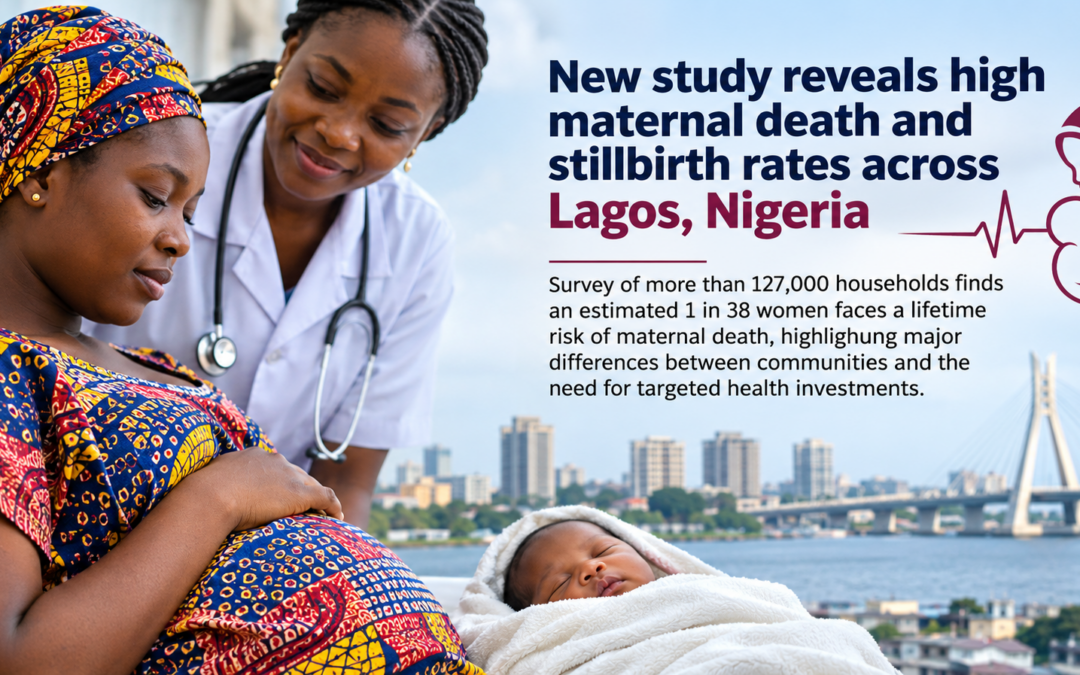
New study reveals high maternal death and stillbirth rates across Lagos, Nigeria
Survey of more than 127,000 households finds an estimated 1 in 38 women faces a lifetime risk of maternal death, highlighting major differences between communities and the need for targeted health investments.
LAGOS, Nigeria — A new study of more than 127,000 households across Lagos State, Nigeria, has revealed high rates of maternal deaths and stillbirths, with substantial differences across local communities. The findings underscore the urgent need for targeted investments in maternal and newborn health care.
Published Oct. 31, 2026, in the peer-reviewed International Journal of Maternal and Child Health and AIDS (IJMA), the study estimates that approximately 1 in 38 women in Lagos faces a lifetime risk of dying from maternal causes. Researchers also estimated 957 maternal deaths per 100,000 live births and 53 stillbirths per 1,000 total births.
The research, led by Dr. Aduragbemi Banke-Thomas of the London School of Hygiene and Tropical Medicine in the United Kingdom, examined pregnancy outcomes across all 20 local government areas in Lagos State. The study provides detailed local-level estimates that could help policymakers identify communities at greatest risk and make better decisions about where to invest limited health resources.
“Broad averages at national and state levels hide local realities,” said Banke-Thomas. “Our estimates show that the burden of maternal death and stillbirth varies widely across the 20 Local Government Areas, and about a quarter of maternal deaths happened at home en route to care.”
Maternal deaths and stillbirths vary widely across Lagos communities
The researchers surveyed 127,039 households and identified 61 maternal deaths and 291 stillbirths among 7,612 births during the study period, which covered March 2023 through February 2025.
The findings revealed striking geographic differences. Badagry and Ifako-Ijaiye recorded some of the highest estimated maternal mortality ratios, while Alimosho and Somolu had particularly high estimated stillbirth rates.
The study also found that approximately 70% of maternal deaths occurred in public or private health facilities, while 25% occurred at home or while women were traveling to seek care. Other deaths occurred in maternity homes or religious facilities.
These findings highlight the importance of understanding where deaths occur and investigating possible gaps in timely access to quality maternal health services.
“Pinpointing where, why, when, and how these deaths occur is the first step to properly channeling our limited resources to where they will save the most lives,” Banke-Thomas said.
Better local data can guide lifesaving investments
Researchers used a sample registration system, an approach that collects information on births and deaths from a representative selection of households rather than relying exclusively on hospital records.
This approach is particularly valuable in settings where official birth and death registration systems may not capture every event.
The study offers a baseline for monitoring maternal deaths and stillbirths in Lagos and identifying communities that may need additional health resources, stronger referral systems and improved emergency obstetric care.
“It is well recognized that policymakers and program planners need to move away from a one-size-fits-all approach towards targeted investments based on robust and granular evidence,” Banke-Thomas said.
The researchers hope their findings will encourage government leaders and development partners to expand community-based systems for tracking maternal and newborn deaths and use the resulting evidence to improve health policies and programs.
Implications for Nigeria and beyond
Nigeria continues to face a substantial burden of maternal and newborn deaths. The findings suggest that statewide and national averages may conceal important differences in health outcomes at the community level.
By identifying where maternal deaths and stillbirths are concentrated, health authorities can better prioritize interventions, allocate resources and evaluate progress toward reducing preventable deaths.
The researchers caution that some local estimates are uncertain because relatively few deaths were recorded in individual areas. Most maternal deaths were also identified through household reports rather than official death certificates. The study therefore provides important baseline estimates, not definitive rankings of communities or proof that maternal mortality has increased since earlier surveys.
The findings reinforce the importance of investing in reliable local health data alongside improvements in maternal and newborn health care.
Journal and research information
Journal: International Journal of Maternal and Child Health and AIDS (IJMA)
Article title: Population-Level Estimates of Maternal Mortality and Stillbirths: A Baseline Survey of 127,000 Households within a Sample Registration System in Lagos State, Nigeria
Lead author: Aduragbemi Banke-Thomas, MBBS, MPH, PhD
Institution: London School of Hygiene and Tropical Medicine, United Kingdom
Method of research: Retrospective cross-sectional household survey
Subject of research: Human populations
Article publication date: Oct. 31, 2026
DOI: https://doi.org/10.21106/IJMA_356_2026
Read the full open-access study: https://mchandaids.org/index.php/ijma/article/view/356/645
About the journal
The International Journal of Maternal and Child Health and AIDS (IJMA) is an international, peer-reviewed, open-access journal published by Global Health and Education Projects, Inc. (GHEP), a U.S.-based nonprofit organization. The journal publishes interdisciplinary research on maternal, neonatal, child and adolescent health, including the impact of HIV/AIDS on these populations, with particular emphasis on health disparities, social determinants of health and vulnerable populations worldwide.
Journal website: https://mchandaids.org
Media contact:
Global Health and Education Projects, Inc.
Email: [email protected]
Website: https://globalhealthprojects.org