by Team GHEP | Jan 17, 2026 | News
WASHINGTON, D.C. AREA — Jan. 16, 2026 — Students at DeMatha Catholic High School in Hyattsville, Maryland, have partnered with Global Health and Education Projects Inc. (GHEP) to help address diaper need among families in the Washington, D.C., metropolitan area.
Through an end-of-the-year diaper drive, members of the DeMatha Service Club donated boxes of baby diapers and wipes to support GHEP’s We Love Babies Diaper Program, which assists families struggling to meet basic infant care needs.
Diaper need — defined as the inability to afford an adequate supply of diapers to keep infants clean, dry, and healthy — affects an estimated one in two families in the United States, according to the National Diaper Bank Network. Public health experts note that many communities in the D.C. region continue to experience heightened diaper insecurity following the COVID-19 pandemic.
The Service Club’s donation drive concluded with a brief presentation ceremony at the high school, where students formally delivered the supplies to GHEP representatives. Accepting the donations on behalf of the organization were Dr. Romuladus (Romey) Azuine, GHEP’s executive director; Dr. Sussan Ekejiuba, director of programs; and Ms. Emily Moaddel, a DSCI Fellow.
In reaching out to GHEP, Mr. William Herman, president of the DeMatha Service Club, said the students were grateful for the opportunity to support GHEP’s work and expressed appreciation for the organization’s commitment to serving vulnerable babies and families in the region.
Ms. Erin Bright, DeMatha’s director of Christian service, said the students selected GHEP after researching local organizations addressing urgent community needs. She noted that the club members were drawn to GHEP’s mission and its focus on supporting underserved families.
Speaking on behalf of GHEP, Dr. Azuine thanked the students and school leadership for the donation and for the care they took in learning about the organization’s work. He said the partnership reflected the students’ commitment not only to academic excellence but also to service rooted in compassion and faith.
Dr. Ekejiuba also expressed appreciation to the DeMatha Service Club, noting that the donated diapers and wipes will directly benefit babies and families across the community. She said the students’ support will help ensure that more infants have access to essential supplies needed for healthy growth and development.
DeMatha’s Service Club provides students with opportunities to explore their interests, develop leadership skills and collaborate on service-oriented projects that contribute to the broader community, according to information published by the school.
Donation and Partnership Information
Individuals, organizations and community groups interested in supporting GHEP are invited to donate or partner with the organization to help expand its impact across underserved communities. Financial contributions, in-kind donations and collaborative partnerships support GHEP’s programs addressing diaper need, public health education, and environmental stewardship. To learn more about how to donate, become a community partner or support ongoing initiatives, visit GHEP’s website and explore opportunities to get involved.
by Team GHEP | Dec 10, 2024 | News
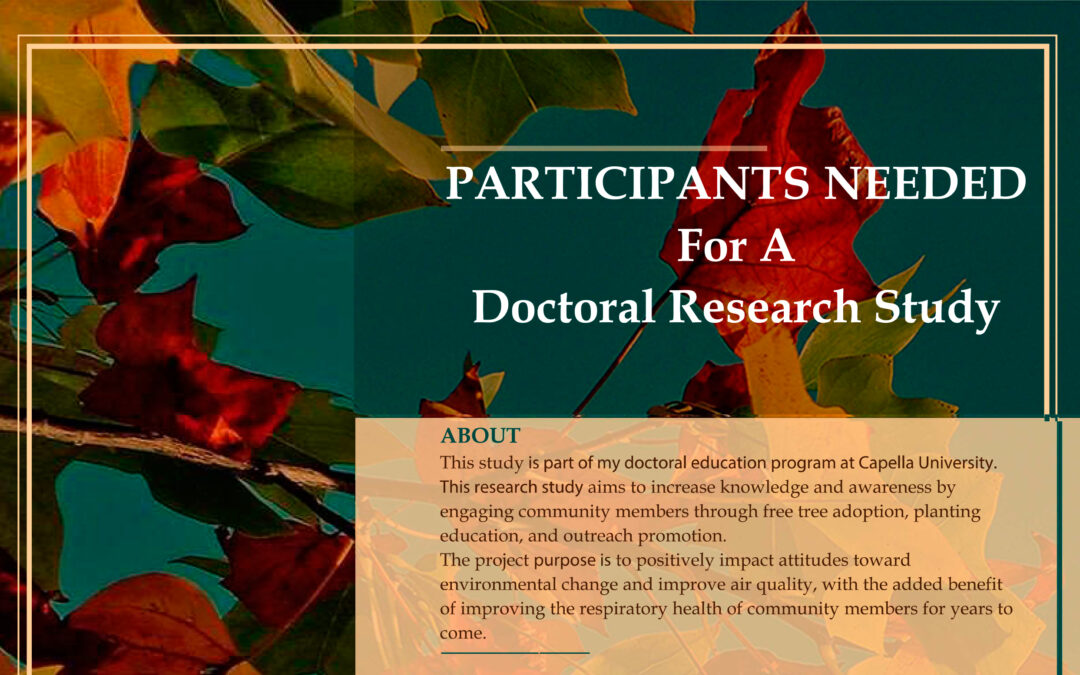
GHEP is excited to partner with Capella University in a public health research study to understand how the Family Tree Adoption Program (FTAP) and tree canopies impact air quality and respiratory health in our area. The purpose of the project is to positively impact attitudes toward environmental change and improve air quality, with the added benefit of improving the respiratory health of community members for years to come.
The study is led by Ms. Archine Perry a doctoral learner at Capella University in the School of Nursing and Health Science. The project is supervised by Dr. James Gambone, winner of the Capella University’s Faculty Excellence Award 2024 with GHEP as a practice site. The title of the study is “Clearing the urban air: an Evidence-Based Practice (EBP) tree adoption program in a Maryland County.”
Participation in this research study is voluntary and will take approximately 15-20 minutes of your time. GHEP strongly encourages members of our community to participate in the study as this will help us get some evidence on how our program is impacting lives.
Please click here to complete the survey.
by Team GHEP | Nov 27, 2024 | News
Washington, DC, USA – November 2024: History of childhood trauma carries negative health impacts across multiple generations of mothers and their children in the United States. This is according to a new study in the GHEP Journal, International Journal of Translational Medical Research and Public Health (IJTRansmed) based in Washington, DC.
The research demonstrates that a history of adverse childhood experiences puts mothers and their babies at a greater risk of acute and long-term health issues, including infections and cancer. Additionally, a partner’s involvement during pregnancy can offset those risks and positively impact the health of mothers and babies.
The study which was led by Amina P. Alio, PhD, a Professor in the Department of Public Health Sciences and the Center for Community Health and Prevention at the University of Rochester and the University of Pittsburgh in the United States, is among the few studies examining the link between maternal trauma in childhood and paternal engagement on a longitudinal basis.
According to the researchers, childhood trauma, referred to as adverse childhood experiences (ACEs) in the study, are traumatic events occurring before age 18, which can come in the form of different types of abuse, neglect, and household dysfunction. In the United States, about 61 percent of adults reported experiencing at least one childhood trauma.
“Exposure to ACEs correlates with various health risks, including depression, alcoholism, stroke, diabetes, and asthma,” warn the study’s authors.
The researchers Interviewed 1,879 new mothers living in Monroe County, New York, between 2015 and 2017. The researchers used prenatal data and maternal history collected from the Monroe County Mothers and Babies Health Survey (MBHS). MBHS is a research initiative focused on assessing the health and well-being of expectant mothers and infants in Monroe County, New York. The 200-question survey was offered in English and Spanish.
They found that women are more affected by ACEs in comparison to men. Expectant mothers experiencing ACEs face increased risks of adverse birth outcomes, such as low birth weight and preterm birth, which can negatively impact the health of infants.
The study also shows that a father’s support during pregnancy can positively impact maternal behavior and child outcomes, such as improved prenatal care and decreased infant mortality.
The research study was titled “Maternal History of Adverse Childhood Experiences and Subsequent Infant Paternal Involvement.”
Read the full article at: https://ijtmrph.org/maternal-history-of-adverse-childhood-experiences-and-subsequent-infant-paternal-involvement/
Media contacts:
If you are a news reporter or journalist and wants to interview the study authors, reach out to the contact below
Rowena Saplala, BS
[email protected]

by Team GHEP | Oct 1, 2024 | News
Washington, DC, & Geneva, Switzerland – The Global Health and Education Projects (GHEP) in Washington, DC, and Concepts Foundation, Geneva, Switzerland are pleased to announce the launch of a dedicated open-access Special Collection on postpartum hemorrhage (PPH) entitled, Implementation Research Evidence for Prevention and Treatment of Postpartum Hemorrhage in High Burden Low-and-Middle-Income Countries.
Limited progress in meeting the Sustainable Development Goal 3.1 maternal mortality target by 2030 necessitates an urgent call to action. PPH (severe bleeding after birth) remains the leading cause of maternal mortality globally, predominantly affecting women in low-and-middle-income countries (LMICs). It is an emergency condition that is preventable but providing adequate and quality care is challenging when health systems face complex barriers.
This Special Collection publication in GHEP Journal, International Journal of Maternal and Child Health (IJMA) contains eight original pilot research studies assessing the introduction of heat-stable carbetocin (HSC) for PPH prevention and tranexamic acid (TXA) for PPH treatment. These are World Health Organization-recommended medicines which address cold chain and storage challenges that compromise the quality of standard practice uterotonics.
Broadly, the implementation research featured spans 9 LMICs and assessed the safety, acceptability, feasibility, and appropriate use of the two medicines. The Special Collection also features an editorial by IJMA, a commentary by Concept Foundation as the guest editors, and a ‘tale of two medicines’ review article arguing the need for an end-to-end approach to introduce maternal health medicines, using HSC and TXA’s access pathways as case studies.
We would like to thank Concept Foundation for their original contributions and for guest editing, as well as the authors, peer-reviewers and editors for their efforts in completing this Special Collection. The research articles provide insightful data collected from a total of over 125,000 women who delivered during the study periods. The research findings collectively demonstrate the safe and appropriate use of HSC and TXA according to the recommendations and the healthcare providers’ favourability of using the medicines.
The articles featured in the Special Collection are as follows:
- IJMA Editorial: Prevention and Treatment of Postpartum Hemorrhage in High Burden Low-and-Middle-Income Countries: Building Cross-National Evidence Through Implementation Research
- Commentary: Feasibility, Acceptability, and Appropriate Use of Novel and Lesser-Used Medicines for Prevention and Treatment of Postpartum Hemorrhage: Evidence from Implementation Research
- Narrative Review: A Tale of Two Medicines: The Need for Ownership, End-to-End Planning and Execution for Development and Introduction of Maternal Health Medicines
- Original Research in Burkina Faso, Ethiopia, Ghana, Sierra Leone, and Uganda: Integrating Heat-Stable Carbetocin and Tranexamic Acid for Prevention and Management of Postpartum Hemorrhage in Sub-Saharan Africa: A Five-Country Pilot Implementation Study
- Original Research in Kenya: Introduction of Heat-Stable Carbetocin for Postpartum Hemorrhage Prevention in Public Sector Hospitals in Kenya: Provider Experience and Policy Insights
- Original Research in Nigeria: An Implementation Research Study on Uterotonics Use Patterns and Heat-stable Carbetocin Acceptability and Safety for Prevention of Postpartum Hemorrhage in Nigeria
- Original Research in Uganda: Postpartum Hemorrhage in Humanitarian Settings: Heat-Stable Carbetocin and Tranexamic Acid Implementation Study in Uganda
- Original Research in South Sudan: Postpartum Hemorrhage in Humanitarian Settings: Heat-Stable Carbetocin and Tranexamic Acid Implementation Study in South Sudan
- Original Research in South Sudan and Uganda: Postpartum Hemorrhage in Humanitarian Settings: Implementation Insights from Using Heat-Stable Carbetocin and Tranexamic Acid
- Original Research in South Sudan and Uganda: Empowering Midwives in Humanitarian Settings: Integrating Heat-Stable Carbetocin and Tranexamic Acid into Postpartum Hemorrhage Training
- Original Research in India: Introduction of Heat-Stable Carbetocin through a Public-Private Partnership Model: A Retrospective Study to Determine Feasibility and Optimal Use in Public Health Settings in India
Maternal health is one of the core thematic areas for IJMA and Concept Foundation. PPH has been at the forefront of Concept Foundation’s maternal health initiatives and continues to be a priority. IJMA aims to publish innovative studies that impact the health of the maternal and child populations around the world, especially in developing countries. “This Special Collection will have global impact on maternal health if translated into practice, especially in resource-constrained settings,” said Dr. Hamisu Salihu, an OB-GYN, and IJMA’s Executive Editor.
This Special Collection presents an impactful opportunity to generate evidence on acceptability and feasibility to introduce HSC and TXA into diverse contexts, as well as shine a spotlight on in-country realities related to cold-chain capability, PPH training gaps and limitations in health information systems for record capture. We very much encourage you to read this Special Collection, in full, as we believe the studies contain valuable research evidence on HSC and TXA as new and lesser-used PPH commodities needed to catalyze policy change and practice to meaningfully advance the field and galvanize action to tackle the unacceptable global burden of PPH.
Click here to access the full Special Collection
The Special Collection was supported by funding from MSD, through its MSD for Mothers initiative and is the sole responsibility of the authors. MSD for Mothers is an initiative of Merck & Co., Inc., Rahway, NJ, USA.
Media contacts:
If you are a news reporter or journalist and wants to interview the study authors, reach out to the contact below
Rowena Saplala, BS
[email protected]
by Team GHEP | Aug 29, 2024 | News
Washington, DC, USA – August 2024: A new study shows that histories of childhood trauma carry intergenerational impacts affecting the health of mothers and their children in the United States.
The research demonstrates that a history of adverse childhood experiences puts mothers and their babies at a greater risk of acute and long-term health issues, including infections and cancer. The study also shows that a partner’s involvement during pregnancy can offset those risks and positively impact the health of mothers and babies.
Interviews and survey responses from 1,879 new mothers living in Monroe County, New York, between 2015 and 2017 informed the research study titled “Maternal History of Adverse Childhood Experiences and Subsequent Infant Paternal Involvement.”
The study was published by researchers from the University of Rochester and the University of Pittsburgh in the United States led by Amina P. Alio, PhD, and published in the open-access scholarly journal International Journal of Transnational Research and Public Health (https://ijtmrph.org/). Their newly published report is among the few studies examining the link between maternal trauma in childhood and paternal engagement.
According to the researchers, childhood trauma, referred to as adverse childhood experiences (ACEs) in the study, are traumatic events occurring before age 18, which can come in the form of different types of abuse, neglect, and household dysfunction. In the United States, about 61 percent of adults reported experiencing at least one childhood trauma.
“Exposure to ACEs correlates with various health risks, including depression, alcoholism, stroke, diabetes, and asthma,” warn the study’s authors.
The results of the research show that women are more affected by ACEs in comparison to men. Expectant mothers experiencing ACEs face increased risks of adverse birth outcomes, such as low birth weight and preterm birth, which can negatively impact the health of infants.
However, the study also shows that a father’s support during pregnancy can positively impact maternal behavior and child outcomes, such as improved prenatal care and decreased infant mortality.
The researchers used prenatal data and maternal history collected from the Monroe County Mothers and Babies Health Survey (MBHS). MBHS is a research initiative focused on assessing the health and well-being of expectant mothers and infants in Monroe County, New York. The 200-question survey was offered in English and Spanish.
Researchers mainly drew their data from interviews and reports by mothers across different income levels. Mothers’ reports included demographic information and health behavior during pregnancy, along with their baby’s father’s information. The researchers also drew from interviews and reports from partners/spouses and other reports to collect their data.
The father’s involvement was measured through co-parenting and their relationship with the mother, financial and emotional investment, quality of time spent, and expressed willingness to rear children.
Looking at a partner’s legal acknowledgment of paternity was one way that researchers tracked paternal involvement in the study. According to the study, acknowledging paternity at birth “lowered infant mortality, preterm birth, and low birth weight risk, particularly for unmarried women with higher ACEs.”
For example, study data showed that when partners acknowledged paternity, exclusive breastfeeding duration increased. Breastfeeding plays an important role in the health of infants and new moms. Increased breastfeeding duration for infants can decrease the risk of infections and adulthood obesity. Increased breastfeeding duration can also decrease maternal risk of breast and ovarian cancer, type 2 diabetes, and high blood pressure.
The study found that mothers with ACEs related to household dysfunction during childhood were at a greater risk of rearing their child without the help of a partner who accepts paternal responsibility.
According to the study, a mother’s ACEs can biologically alter her stress responses, possibly due to long-term changes in the hypothalamic–pituitary–adrenal (HPA) axis functioning. The study’s authors point out that this can lead to a heightened sensitivity to stress and negative cues (for example, negative facial expressions like frowns and negative body language like arms folded over the chest).
“Together, these biological and psychosocial effects of ACEs intricately weave into the fabric of maternal behavior,” the study’s authors say.
From a biopsychological view, a mother’s ACEs experiences could influence how her HPA axis functions. When HPA is altered, this can lead to increased stress sensitivity and maladaptive responses to stress. These physiological changes can in turn affect maternal behaviors and relationship dynamics. These effects can manifest as decreased partner involvement in caregiving and supportive roles.
The study emphasizes that ACEs can have transgenerational effects and directly impact the mother’s immediate offspring. “This creates a cycle involving ACEs,” involving lack of paternal support, possible household dysfunction, and a repetition of ACE’s “perpetuating across generations” if there is no intervention,” they warn.
The study’s authors say that targeted support mechanisms could help increase paternal engagement to help offset the long-term affects of maternal ACEs.
“Actionable interventions could include initiating ACE screenings during pregnancy, delivering specialized psychological support to at-risk mothers, enhancing relationship counseling during the perinatal period, and forming networks for linkage to community resources,” the study’s authors urge.
Media contacts:
If you are a news reporter or journalist and wants to interview the study authors, reach out to the contact below
Rowena Saplala, BS
[email protected]

by Team GHEP | Feb 26, 2024 | News
Collaboration aims to strengthen support of African authors working in health research.
Health issues are one of Africa’s most pressing concerns. Fortunately, hard work is being performed to help meet these often critical needs. The Global Health and Education Projects (GHEP), a United States-registered 501(c)(3) non-profit organization committed to tackling global health inequalities, is pleased to announce the signing of a memorandum of understanding (MOU) with the Kano Independent Research Centre Trust (KIRCT), Nigeria. This partnership underscores GHEP’s commitment to supporting African authors in publishing health-related work and amplifying the global impact of its initiatives while working with like-minded global partners.
Romuladus Azuine, Dr.PH., M.P.H., Executive Director of GHEP, emphasized the significance of this collaboration, stating, “Our partnership with Kano Independent Research Centre Trust marks a crucial step in our mission to bridge health disparities and promote global health equity through global health research.”
Established in 2013 by Pfizer Inc. for the Kano State Government in Nigeria, KIRCT specializes in biomedical and healthcare research, focusing on both communicable and non-communicable diseases in Nigeria and across the African continent.
Hamisu Salihu, M.D., Ph.D., the Director General of KIRCT, highlighted the comprehensive services offered by the center, including clinical services for diseases such as HIV/AIDS, TB, Measles, Hepatitis, Malaria, Asthma, Maternal and Child health, and more. KIRCT also provides a range of laboratory services, medical research, and training related to diagnostics, clinical trials for drugs/vaccines, and human capacity strengthening.
Dr. Salihu expressed enthusiasm about the collaboration, stating, “This partnership with GHEP aligns with our mission of advancing healthcare research and addressing public health challenges in Africa. Together, we aim to make a meaningful impact on the health and well-being of communities.”
The collaboration between GHEP and KIRCT encompasses several vital objectives. KIRCT will serve as the Africa office for GHEP’s two prominent journals: The International Journal of Maternal and Child Health and AIDS (IJMA) and the International Journal of Translational Medical Research and Public Health (IJTMRPH).
The two organizations will co-sponsor publication scholarships to support African authors contributing to GHEP publications as part of this collaboration. Additionally, they will mentor researchers and institutions in Nigeria and other African countries, assisting in preparing high-quality articles suitable for publication in the journals. This includes support with study design, review, and technical writing for Nigerian researchers.
Gopal Singh, Ph.D., MSc., GHEP Journals Editor, remarked on the organization’s commitment to open-access publishing, stating, “The MOU with KIRCT is a significant milestone in GHEP’s mission to advance health equity. By providing avenues for researchers from developing countries to publish in reputable open-access journals, we are contributing to the global dissemination of valuable research.”
This collaboration reflects GHEP’s dedication to breaking intergenerational cycles of health and education disparities and socioeconomic adversities by facilitating access to opportunities and resources. For more information about GHEP and its impactful initiatives, please visit www.globalhealthprojects.org or email to: [email protected]
Media Contact:
Romuladus E. Azuine, DrPH, MPH
Executive Director
[email protected]
240-476-2881
www.globalhealthprojects.org