by Romuladus Azuine | Apr 10, 2024 | Blog
As we all have witnessed, the COVID-19 pandemic led to a significant shift from traditional in-person learning to virtual public health programs. However, these public health programs are more than just today’s educational requisites. Remote public health internships, in fact, opened gateways to new and exciting opportunities for growing numbers of young talent aspiring to make a career.
The most important part is these internships prepare students and professionals alike with actual experience, which is an integral component of making successful careers in the years to come. If you are here, chances are you are looking for the best virtual public health internship to help you through the process. Thankfully, we are here to help you.
In this blog post, we will help you through the nitty-gritty of securing a remote internship in public health while telling you tips and tricks to maximize your learning experience once you are in a public health internship.
Remote Public Health Internship: The Basics
“The remote public health internship is a virtual experience for students and early career professionals to have an opportunity to exercise work related to public health projects, research, and initiatives without having to physically be at the site of an internship.”
These internships vary widely in scope. For example, they may be the typical type where students conduct research in public health under senior mentorship. In contrast, you can also choose programs that help you learn the management of the public health system or guide you through the process of policy development. The common thread in these programs is that they can give you real-world experience of public health principles and skills in a virtual setting.
Additionally, you must know the difference between a few terms – internship, practicum, and capstone – to guide you through the different stages of education. While a practicum is generally a focused, narrower experience within a specified area of public health, an internship offers a much broader experience. On the other hand, capstone projects require students to conduct comprehensive research or program development that ties together the practical and theoretical components of the public health education program.
Why Should You Go for a Remote Public Health Internship?
Remote public health internships offer a wide range of benefits. First and most importantly, they are flexible, so you can easily balance your studies, work, and personal life. Second, you get far-reaching access to the best organizations and experts worldwide, regardless of your geographical location.
These remote opportunities help you implement theoretical knowledge in practice, acquire professional skills, and gain professional contacts in your area of interest. This practical experience is often a key point for employers in the public health sector, and internship experience becomes central to preparing for jobs in public health. Therefore, we can confidently say that the experience from these public health internships helps you prepare for and ultimately secure a professional job in the field of public health.
How to Find the Best Remote Public Health Internship for You?
Identify Your Goals
To secure an internship that might change your life for good, it pays to fully understand your career objectives. You may be fascinated with epidemiology, biostatistics, social and behavioral sciences, policy and administration, community health, global health issues, or public health policy. Understanding these basics helps you pinpoint an internship that offers targeted experience, enriching learning and professional development.
Evaluate the Internship Provider
If you want to make a difference by enrolling in a remote public health internship, you should choose highly credited and reputed organizations. Based on reviews from students and professionals, we are one of the organizations with the highest reputation in the field of public health training. Our remote internships are high-quality, rigorous, relevant to current public health challenges, and would add considerable value to any resume. Our remote public health programs are designed to align with the competencies of the Council for Education in Public Health (CEPH). And why is this important? This means that the program and activities that you complete while participating in our remote public health internships are specifically targeted at giving you the knowledge, skills, and abilities to perform creditable in an entry-level position in public health.
University Partnerships
You can find opportunities through your university’s partnerships with public health organizations. We cooperate very closely with universities and colleges, providing remote public health internships that allow students to back the theory up with practice. Some of the universities we partner with include George Washington University, Liberty University, Eastern Washington University, Florida International University, University of West Florida, Capella University, and Walden University to mention but a few. Establishing these partnerships involve vetting of the PH360 program and review of the qualification of the staff who deliver the program and who become your supervisors, preceptors, or mentors during the programs. This allows you to enjoy the smooth transition of your academic curriculum into the actual running of public health programs.
Utilize Professional Associations and Platforms
Last but not least, professional public health associations and dedicated online platforms are excellent resources for finding internship opportunities.
Public Health 360: Best Remote Internship for You!
Public Health 360 (PH360) is not just another regular program. It is a unique, cutting-edge workforce development initiative devised by Global Health and Education Projects (GHEP) to bridge the gap between academic theory and field practice. PH360 ensures that you complete the remote internship mastering the three core functions of public health – assurance, assessment, policy development undergirded by research and service.
PH360 offers hands-on experience for a diverse group of individuals,
- Graduates from non-public health majors.
- Undergraduates from health or non-health-related majors who aim to bridge the gap between their academic knowledge and an actual job.
- Practicing public health practitioners who want to polish their skills.
- Students at all academic levels who need a mentored, project-based internship experience.
What Makes Us Stand Out?
We understand there are too many options for finding the best remote public health internship. The search becomes even more challenging when you aim for meaningful hands-on experience. Knowing the complexity and seriousness of the situation, we are offering you the best program you can find.
Our remote public health internship, PH 360, differs due to our uncompromised commitment to an immersive, impactful, and complete learning experience. We offer you the most rewarding curriculum presented by top scientists and leaders in public health. Thus, our internships will help practice skills development and experience improvement with employability enhancement to enable a shining professional career in public health with a global perspective.
How to Maximize Your Learning Experience?
Now that you have nabbed the perfect remote public health internship opportunity, it’s time to really make the most of it. For this, you must set clear, achievable goals and stay on top of your work by engaging your supervisor and team with project contributions.
If you proactively work and continuously ask for constructive feedback, you will surely have an extraordinary and enriching experience. Yet another very crucial way of making the best of your internship time is networking.
Get to understand who the professionals in this organization are, attend virtual seminars and workshops, and participate in relevant online forums. Through this, you will understand more about public health and possibly get job opportunities.
The Bottom Line
Remote public health internships offer the most flexible pathway for students and early professionals to get experience in their desired field, and there is no second thought to it. Through these opportunities, you can get the essential skills, develop a professional network, and form the foundation for successful careers in public health.
So why the wait?
Join our top-notch internship programs, and let us be the stepping stone toward the fulfilment of your career.

by Juliana Schifferes | May 31, 2023 | Blog
The month of May every year has been dubbed Healthy Vision Month by the U.S. Centers for Disease Control and Prevention (CDC). Related to the Healthy Vision Initiative, this month commemorates and brings to light the importance of healthy eyes. Eye health, regardless of whether one is born with intact vision or not, can have an intrinsic relationship to overall well-being, success and even brain health.
Do you have near-sightedness, far-sightedness or something more serious like glaucoma? Well, there is only one way to find out. An eye exam. According to the NIH (National Institutes of Health, US), 48 million people suffer from near- or farsightedness (or refractive errors); 3 million from glaucoma, approximately; 8 million from diabetic retinopathy (a complication from diabetes); and even more, implying a significant chunk of the population is at risk.
Barriers remain. Despite the wallet- and life-saving tendencies of eye exams to rule out dangers like untreated glaucoma, diabetes-induced blindness and near-blindness (legal blindness, often related to more common incidences like farsightedness and nearsightedness) the procedure is out of reach for many.
In many localities, a systemic lack of availability for eye care plagues towns and even nations, leading to disease and discomfort. While stereotypically this may occur in the developing world, it bears noting this takes place in the US as well.
With so many barriers to eye care around us, it bears noting what the social determinants of health are. The social determinants of health, in simplified form, are the conditions in which residents live, work and play. GHEP works to address the social determinants of health. One of these determinants is economic stability that enables healthcare access in the first place, another is the quality of healthcare.
Economic stability is exactly what it sounds like. Can one afford basic life essentials to survive and have a decent quality of life? Stability is not income-based, rather it is based on whether available resources correspond to current means. Translation? Economic stability depends on how much money you need to live the life you need–not the best life or the most ideal life, but the one where your health can still be supported.
Saving up for healthcare is not a problem of willpower. It is a problem of insurance. In the US, insurance is provided either through government or employer, and for people who do not have sufficient, or even any, insurance fall through the cracks. Amongst these populations are young people who are not yet at a state of employment that can provide for their needs.
Another issue that prevents access to good healthcare is simply logistical. Many doctors’ offices have long waiting lists to see patients, which means that many ill people, some of whom have multiple jobs, may miss narrow windows of opportunity for care. At the same time, eye exams at department stores exist for people without significant conditions and usually with the expectation that “patients” will become customers and buy eyeglasses.
As a young American, like those in my age group, I am fortunate in many ways. But in other ways, I envy many European nations where I could access healthcare subsidized or provided by the central government, such as the UK or Germany. I am just starting my career and experiencing what my world would like without insured healthcare, or healthcare with wide coverage in general. This includes the gallows humor joke about why dental and eye insurance are separate from regular insurance: “teeth and eyes aren’t part of the body!” Jokes aside, a sense of absurdity and callousness pervades the experiences of many Americans–as though they could pick and choose what body part falls ill first.
It is crucial to imagine a world where everyone could see clearly–literally–either in terms of their own personal health or policy needs. We only need a new pair of lenses to imagine the possibility of a health-driven, rather than paperwork- or profit-driven healthcare system. While doctors and insurance brokers deserve to earn a living, the welfare of their patients and the professionals who serve them should not approach a zero sum game in terms of profits and fees. But with worthy initiatives and caring stakeholders like you and I, change can become possible.
At GHEP, we are committed to making that world possible. We believe that if we support our Public Health 360 (PH360) burgeoning leaders, trainees in a program dedicated to the bridge between theory and academic practice, they will support structural and policy change in whatever field or nation they are working in.
Several of our graduates, in fact, are already making change; like Dr. Driss of Burundi, who manages community health workers in making community care accessible and affordable. While this appears far afield from policy change in the US, this relates to our training program’s strengths in imparting change globally and not just at our home base in the US.
You can join us as a changemaker and remedy injustice with us as a PH360 intern starting this summer. Join today and stand up to disparities home and abroad: https://globalhealthprojects.org/public-health-360/.
Sources
Eye Disease Statistics. National Eye Institute. National Institutes of Health. Updated March 2014. Accessed May 26 2023. https://www.nei.nih.gov/sites/default/files/2019-04/NEI_Eye_Disease_Statistics_Factsheet_2014_V10.pdf
Healthy Vision Month. Centers for Disease Control and Prevention. Updated December 19 2022. Accessed May 20 2023. https://www.cdc.gov/visionhealth/healthyvisionmonth/index.htm
Social Determinants of Health: Economic Stability and SDOH. Updated June 2021. Accessed May 20 2023. https://www.cwla.org/wp-content/uploads/2021/06/SDOH-One-Pager-EconomicStability.pdf
by Juliana Schifferes | Mar 31, 2023 | Celebration, Blog
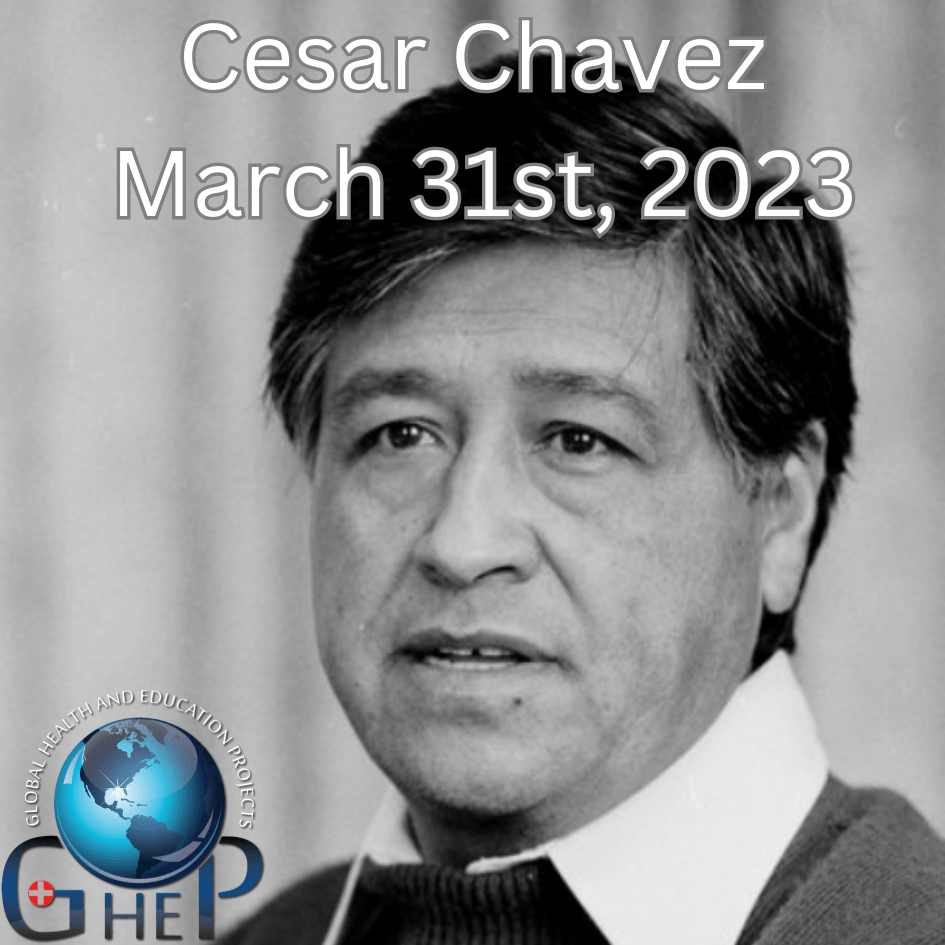
On March 31st, we celebrate Cesar Chavez Day. Cesar Chavez is a hero to many Americans in the labor movement. But who is he outside these circles? And why does it matter?
Cesar Chavez is one of the only Hispanic/Latino people nominated for a holiday or observance. While it is less than desirable that he is the only Hispanic person so honored, perhaps it also reflects the magnitude of his achievements.
According to the American Federation of Labor and Congress of Industrial Organizations (AFL-CIO), the largest federation of unions in the United States, Chavez was born and died in the place he lived to serve, the Western United States–specifically, he was born in Arizona. Then he served as a labor leader to unionize thousands of farm workers to fight against employer oppression across the country and passed away while visiting Arizona to negotiate a labor deal. Unionization is when workers or professionals join forces in order to form a larger organization (called a union) which is thereby used as a collective vehicle to negotiate, confront and bargain with employers when necessary.
As a powerful union leader, he led the unionization of an immense number of farm laborers. He was the chief organizer of the United Farm Workers, which challenged powerful grape-producing companies that exploited the working poor, especially manual laborers.
Why does this matter to employers? It teaches them to respect their employees, especially those least likely to have a place at the table. That is because they will demand a place at the table if they are denied one, and perhaps will take it for themselves.
This is not a negative. Instead it is an inevitability that the vulnerable will seek out equality, including forms of equality related to the conditions that they live or work in.
At GHEP, we believe that everyone is worthy of equal treatment. Human rights are fundamental and cannot be challenged. Therefore, as part of the social determinants of health (SDOH), we support the best living and working conditions for all people, socially and economically.
We also support the rights of workers across the world in numerous ways. For example, in our Public Health 360 class and for our employees, we welcome feedback and encourage work-life balance. This demonstrates how much we value the lessons from workers across the world and here at home. That there is dignity in work and the economic self-sufficiency that comes with work is at the heart of GHEP’s efforts on social determinants of health.
Why does GHEP care about Chavez, specific to our organization? He is a BIPOC hero to us, someone bent on supporting the least advantaged and raising them up to the level of power they deserve. And why should you care about Chavez?
Chavez is an example of a BIPOC individual in the limelight who has made a palpably and intensely felt difference in the world. He made sure heinous treatment against workers did not go unnoticed and was corrected.
Celebrate Cesar Chavez Day this March through several possible ways. Explore relevant legislation, such as focusing on the minimum wage or protections for workers in dangerous industries, and see how you can provide support. Check out your local unions and see if your work is relevant. Finally, consider donating to GHEP so we can continue to provide programs that support the community and keep the fires burning after Cesar Chavez. Change is possible!
by Juliana Schifferes | Feb 21, 2023 | Blog, Celebration
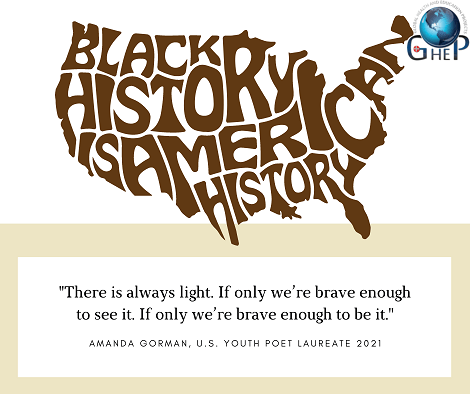
Black History Month is every February. It is a time to celebrate the successes and triumphs of the African American community. This year’s celebration recognizes the great battle against repression and disenfranchisement that surrounds Black Americans from the distant past and up until the present day.
According to the History Channel, Black History Month, also known as African American History Month, grew out of “Negro History Week,” and was the brainchild of noted historian Carter G. Woodson and other prominent African Americans. The History Channel chronicles that since 1976, every U.S. president has officially designated the month of February as Black History Month. Other countries around the world, including Canada and the United Kingdom, also devote a month to celebrating Black history.
Accordingly, the 2023 Black History Month’s theme is “black resistance.”
Amanda Gorman, youth African American poet laureate in 2021, delivered a resounding and relevant address to the nation at the latest presidential inauguration of President Biden. One of her most crucial statements in her inauguration poem: “There is always light. If only we’re brave enough to see it. If only we’re brave enough to be it.” Spreading knowledge and inaugurating positive new beginnings–becoming light and not forces for darkness–is the point of resistance. Resistance is not about aggression, though confrontation may sometimes be necessary. It is about supporting each other to create a distinctive force for change and to fight against the past.
Enough words! Let’s have some music (as musically attuned as Gorman’s words are). Janelle Monae, the unbelievably prolific African American soundtrack creator, fashion powerhouse, rapper and singer demonstrates she’s an intersectional double threat. Namely, she focuses on LGBTQ+ pride and the strength of her black identity. She is shaping a positive sense of identity for all. And in 2015, she released a song to say the names of black people who lost their lives to police, humanizing them as individuals rather than letting them be statistics (“Hell You Talmbout”).
But black culture is not just pop culture. Dr. Dorceta Taylor, an African American, put the concept of environmental racism on the map. Author of two (academic) blockbusters–The Rise of the American Conservation Movement and Toxic Communities–Dr. Taylor is a giant of the environmental field who has reshaped the environmentalist and environmental studies landscape. Why should this matter to you? Because environmental justice frames the conversation of nature access and environmental health as an equity and civil rights, rather than as a “color-blind,” issue.
Finally, politicians have made the fight against oppression practical ever since it became possible for black people to get elected (mostly after the heroic actions of the civil rights era). The fruit of centuries of efforts even yielded the ascendancy of an Indian American and African American Vice President, Kamala Harris. Senator Cory Booker, an African American, perhaps said it best: “Hope is the active conviction that despair will never have the last word.” And for Senator Booker and others like him, hope is a crucial part of resistance–an antidote against painful circumstances.
But other unsung heroes exist. Today, we would like to highlight GHEP’s Family Tree Adoption Program participants and diaper program recipients for their small resistance. Rather than sinking to circumstances, our diverse client population opts for hope in changing their lives. They implement environmental justice into their lives by planting trees and shrubs, while diaper recipients improve their well-being and their children’s by collecting diapers from our diaper bank.
We hope this post has brought you hope and energy to do good work that will benefit the community. Enjoy your celebrations. What are you doing for Black History Month? Drop us a note and let us know.

by Romuladus Azuine | Feb 17, 2023 | Blog
The COVID-19 pandemic exposed many inadequacies in the global public health system and security. First, it drove home the message that the health of the world is interdependent. No more African health; no more this is American health; no more we need to protect the health of our own people. It is now evident that it is “our health”—our globalized health is real. Second, it showed that although we are getting slightly better, the world is still ill-equipped to address global health crises. Third, it exposed the acute shortage of public health professionals who are so critically needed at every level of government to protect public health.
Having bodies called public health professionals is no good if they are unprepared to address the next impending global health security challenge lurking around. The world, and that is different parts of the world, needs well-educated and well-prepared public health professionals who will be at the vanguard of upholding and protecting public health. The US-based Council on Education for Public Health (CEPH), prescribes a number of competencies for public health practitioners ranging from epidemiology, social and behavioral sciences, program evaluation, biostatistics, etc. CEPH is an independent agency recognized by the U.S. Department of Education to accredit schools of public health, and public health programs outside schools of public health.
That’s why I am excited about the next cohort of #publichealth360. This cohort will bring together emerging professionals and committed individuals from across the WHO’s region who will immerse themselves in deep learning in the art, science, and craft of public health. Using the CEPH competency framework, we are able to empower would-be public health professionals with the skills they need to work in the community, at the county level, country-level or global level protecting all of our health. I’m glad that Public Health 360 is back again. Our pre and post-test evaluations tell us who is ready and who is prepared to earn the title, public health professional. The wait is over.

by Romuladus Azuine | Feb 12, 2023 | Blog
Many of my mentees and followers have asked: “Dr. Romey, I have all this education with all these degrees, why am I not landing jobs as fast as I would like to?” This is a question that I know is in the minds of many young graduates or others desirous of landing their first jobs upon graduation.
In my response, I always use the above tag line. And I believe every letter in that statement. This tag line succinctly summarizes what school (call it college or university and the attendant degrees) does and what it does not. Understanding what school does and does not do is the foundation for saving yourself the melancholy of school-bashing and unrealistic expectations.
The reason why people graduate from school and do not land a job immediately can be attributed to school versus employment (SvE) gap. This refers to the gap between one’s academic qualifications and competencies / skills for entry-level job readiness. SvE gap is the secret sauce between what an individual gets from attending school and what they need to actually be successful in employment.
In a fiercely competitive labor market, it is because of this that folks make such misguided statements like: “education is overestimated, universities are scam, or education is fraud.” Don’t believe them. Rather than go derogatory about school or college, step back and ask yourself, what does school give me and how am I using what school gave me to land me a job? Where is my SvE gap and how can I fill it?
Managers, supervisors, and employers of labor will tell you about SvE gap. Schools generally arm you with the foundation to ingest skills—this includes the foundation to learn new skills fast, the foundation for broader mindset to work in a team, the preparedness to go the extra mile to fill a gap in your knowledge without prompting, etc. However, employers are looking for skills to be applied in a job position, right now. This inherent gap must be filled in order for the new graduate to land their first job and rise from there. It is the difference between attitude and altitude.
Every potential college graduate needs to fill their SvE gap while they are in school or work hard immediately upon graduation to fill them in roles for which employment expectations are not raised. These may include internships, practicums, volunteer-experiences, paid or unpaid fellowship.
It is OK if those are free, for example through volunteer opportunities. It is also OK if those are paid short-term programs where for the tuition you get an intensive hands-on competency that will propel you to the next job by filling the gap between school and employment. Fortunately, many remote platforms make it easy for graduates to gain meaningful experiences covering their SvE gap and get them better ready to land their first roles in public health or other fields.